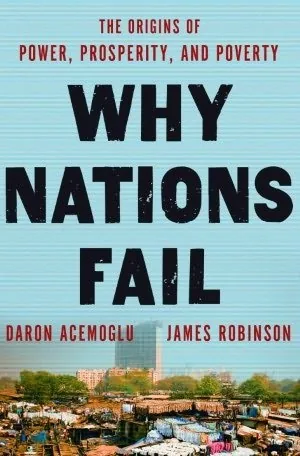
Cover via Open Library
Matt's pick · not sponsored
Why Nations Fail
- institutions
- development
- inequality
- democracy
- Nobel Prize
- poverty
Buy on Amazon(paid referral link)
As an Amazon Associate I earn from qualifying purchases. Full disclosure
Why I'd hand it to you
Acemoglu and Robinson, who later shared a Nobel Prize in economics, argue that countries become rich or stay poor mainly because of their institutions. When power and opportunity are spread widely, societies tend to grow; when a small group captures them, they stall. Their examples range from the two Koreas to the two halves of Nogales on the US-Mexico border. It is a big idea that helps make sense of a lot of history and news. It is also long, and it hammers the same point repeatedly. Critics say the theory is tidier than the real world. It is still worth reading.
— Matt Jordan
Quick summary
- Book
- Why Nations Fail by Daron Acemoglu, James A. Robinson
- Who it's for
- Readers who want one big idea for making sense of history and the news, and who can tolerate repetition.
- Key topics
- Institutions and power
- Why some nations grow rich and others stay poor
- Inequality and development
- Democracy
- Shelves
- Economics, World Affairs, History
Details
- Author
- Daron Acemoglu, James A. Robinson
- ASIN
- 0307719227
- On these shelves
- Economics World Affairs History
- Short link
mattsbooks.org/r/nfai